

%201.svg)


As industrial systems modernise, there has been a strong focus on automation for efficiency. Advances in digital systems and analytics have delivered significant improvements in both productivity and output. However, these achievements still depend on a more fundamental factor: the operational reliability of the machinery. Despite its central role in determining performance and cost, equipment maintenance has often received less attention than other aspects of the system. In many cases, organisations continue to rely on set schedules or failures to determine asset conditions. This approach glosses over the fact that maintenance decisions directly influence efficiency, downtime, operating costs, and in turn, the bottom line.
Historically, organisations have relied on several main approaches to maintenance. Reactive maintenance involves addressing failures only after they occur. While simple to implement, this approach often results in higher repair costs, shortened equipment lifespan, and unplanned downtime that disrupts operations and reduces productivity.
An improvement on the reactive approach is preventative maintenance, where machinery is inspected and serviced on a fixed schedule. These schedules are usually based on manufacturer recommendations and the historical performance for each type of machine. While this approach can reduce the frequency and likelihood of failures, it assumes that equipment degradation and breakdown follows set timelines. However, in reality, equipment health is influenced by factors such as usage, operating conditions, environmental stressors and more. As a result of overlooking these factors, preventative maintenance can lead to unnecessary servicing or failures occurring between inspections.
The limitations of reactive and preventative maintenance has driven the development of predictive maintenance, which is the focus of this article. Predictive maintenance is a more proactive, data-driven approach that builds on real-time monitoring and continuous assessment to optimise equipment performance and extend asset lifespan.
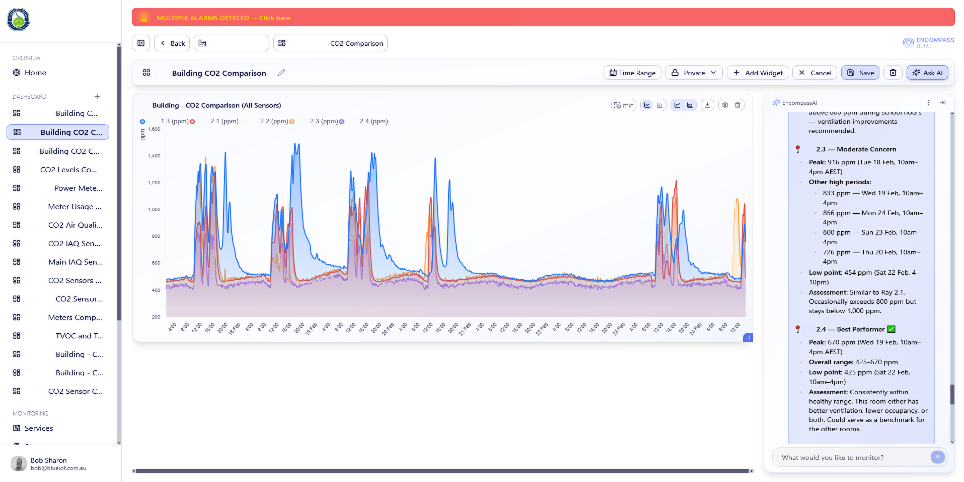
Predictive maintenance extends beyond set-interval maintenance by continuously monitoring the actual condition of equipment rather than the expected condition. This approach leverages broad networks of sensors that collect real-time operational data, including temperature, vibration, pressure, energy consumption, output efficiency and more. The data captured by these sensors is then analysed using predictive models that combine artificial intelligence, machine learning techniques, and advanced analytics. By examining historical time-series data, these systems establish a baseline of normal operating behaviour for each asset. This baseline represents the expected performance of the asset under normal conditions. The system is then able to compare the current operating conditions of an asset against this baseline. Even minor deviations, like small drops in efficiency or irregular performance patterns, can be detected early. This allows emerging issues to be identified early, and maintenance scheduled before inefficiencies turn into failures.
As more data is collected over time, predictive maintenance systems become increasingly stable and accurate. The longer the system is in place, the better AI-driven models understand the operating characteristics of each machine, improving the accuracy of predictions, alerts, insights, and recommendations over time. By monitoring operations in real time, organisations can better optimise their maintenance schedules, anticipate the future of asset health, and intervene before breakdowns actually occur.
The main objective of predictive maintenance is to maintain asset performance while minimising downtime and unnecessary maintenance activity. Achieving this goal delivers a wide range of operational, financial, and organisational benefits.
One of the most significant advantages of a predictive maintenance model is the increased ability to anticipate equipment failures with greater certainty than that of traditional maintenance models. Advanced warnings and alerts enable issues to be addressed before breakdowns occur, reducing repair costs, preventing secondary or more permanent damage to machinery, and avoiding downtime.
Downtime is extremely costly, and in fact, the world’s 500 largest companies lose an estimated 11% of their annual revenue due to unexpected downtime, while manufacturing facilities alone lose between 5% and 20% of production capacity due to equipment failure and related disruptions. However, research from Deloitte indicates that predictive maintenance can reduce facility downtime by between 5% and 15%, ultimately increasing savings. Beyond early fault detection, predictive maintenance further supports uptime by strengthening procurement planning. Improved visibility into component health allows organisations to anticipate part failures, order replacements in advance, and avoid delays caused by last-minute sourcing, helping keep operations running even amid supply chain disruptions.
Predictive maintenance also supports more efficient maintenance operations. Data-driven insights allow organisations to track metrics like the mean time between failures and the average repair times for each individual asset. This allows maintenance to be scheduled based on actual equipment condition, avoiding the cost of unnecessary servicing while also reducing the risk of expensive failures. This results in a more efficient and effective maintenance workflow.
This improved maintenance workflow directly enhances equipment performance and reliability. By maintaining assets based on their actual operating condition, organisations can reduce wear and tear and prevent the secondary damage that often accompanies degrading or failing machinery. Over time, this extends asset lifespan and allows businesses to extract greater value from existing capital investments, rather than replacing equipment prematurely due to inadequate maintenance.
Predictive maintenance also offers significant benefits for the workforce itself. Equipment failures pose serious safety risks, particularly in industrial environments. Around 18,000 US workers are injured every year while operating or maintaining machinery and according to the Occupational Safety and Health Administration, more than 800 individuals die. Identifying faults before dangerous failures occur is necessary to reduce the likelihood of hazardous accidents.
Beyond safety, predictive maintenance empowers teams by shifting maintenance from reactive repairs to proactive planning.Improved visibility into equipment condition, enabled by AI-driven analysis, allows technicians to prioritise work, reduce emergency callouts, and operate in a more predictable environment. This not only improves morale, but also increases efficiency. Deloitte estimates that predictive maintenance can drive a 5% to 20% increase in labour productivity by enabling better use of skilled labour and reducing reactive workloads.
Predictive maintenance also improves outcomes for end users. Equipment operating outside optimal parameters can compromise product quality, leading to defects and waste. Ensuring machinery consistently performs up to standard supports stronger quality control and more reliable production results.
Predictive maintenance can also contribute to sustainability goals. Machinery operating inefficiently often consumes increased levels of energy to achieve the same output, increasing operational costs and environmental impact. Predictive systems can flag inefficiencies, allowing organisations to respond with maintenance, ultimately reducing energy waste and associated emissions.
Throughout this article, predictive maintenance has been discussed primarily in the context of manufacturing. This is intentional as manufacturing environments are currently some of the most mature and intuitive applications of predictive maintenance. This is because these environments rely heavily on complex machinery operating continuously. In these settings, equipment performance, downtime, product quality, and maintenance decisions have a direct and immediate impact on productivity and cost.
That being said, the same predictive maintenance principles extend beyond the manufacturing sector. In the energy sector, predictive maintenance can help prevent power outages through early detection of asset degradation across generation and distribution systems. In rail and transport, it enables earlier detection of issues like brake wear, track defects, or signalling failures, supporting safer and more reliable travel. In civil infrastructure, predictive analytics can improve assessments of structural integrity between inspection cycles, allowing potential issues to be identified before they become critical and hazardous.
Across all of these vastly different industries, predictive maintenance supports a similar set of use cases. It can be used for outage prevention by identifying early indicators of failure, such as irregular behaviour or patterns. It enables continuous condition monitoring by analysing real-time equipment data to detect abnormalities or emerging trends. Predictive maintenance also supports anomaly detection, service prioritisation, and dynamic scheduling, allowing teams to allocate resources where they are most needed. Finally, it plays a major role in energy optimisation, as inefficient or degrading equipment often consumes more energy just to deliver the same output. By identifying these issues early, organisations can schedule targeted repairs and reduce unnecessary energy consumption. While manufacturing remains the most mature application today, these examples demonstrate how predictive maintenance is expanding to new asset-intensive industries and capabilities.
Despite its benefits, there are some challenges associated with implementing a predictive maintenance system. Initial infrastructure costs can be significant, as organisations must invest not only in hardware like sensors, but also in the analytical machine learning platform that is required to process and interpret the data itself. Furthermore, these costs are often higher for organisations upgrading legacy equipment or building systems from scratch, where integration and planning can be complex. In many cases, the hardware-inclusive nature of predictive maintenance also requires a substantial upfront investment which can put financial strain on businesses adopting this model.
Workforce training is another significant challenge as predictive maintenance introduces new tools, technologies and workflows that require teams to adapt and work differently than other traditional maintenance models. This shift can require time, structured training, and, in some cases, new roles or organisational structures to ensure the system is used effectively and delivers its intended purpose. Together, these factors can make implementation costly and challenging without the right support.
Many organisations address these challenges by partnering with specialist providers who can deploy, manage, interpret, and scale predictive maintenance solutions. This approach allows organisations to access advanced, data-driven capabilities without the need to build extensive in-house expertise or invest heavily in designing and implementing complex systems.
Predictive maintenance represents an extension of traditional maintenance models. By building on reactive and preventive approaches and combining them with modern sensor technology, advanced analytics, and machine learning, predictive maintenance can fundamentally change how organisations understand and manage asset operability. Rather than relying on fixed schedules, assumptions, or historical averages, predictive maintenance provides continuous insight into the actual condition of equipment. This shift from estimation to certainty delivers clear operational, financial, and environmental benefits.
As these benefits become increasingly critical, competition increases, and margins tighten, continuing to operate without a clear understanding of equipment health becomes a growing source of inefficiency and avoidable cost. By adopting predictive maintenance, manufacturers can move beyond guesswork and reactive decision-making, gaining greater control over the systems that form the backbone of their operations. In doing so, they are better positioned to improve productivity, reduce waste, protect their workforce, and operate more efficiently in an increasingly competitive landscape.