
Back to News

Indoor Air Quality

Discover more articles and stay updated with our latest content

July 5, 2025
6
min read
author
Blue IoT Team
Summary
Poor indoor air quality silently compromises health, cognitive function, and productivity. Discover how smart monitoring and strategic design can transform IAQ into a cornerstone of healthy, sustainable buildings.
tags
Indoor Air Quality
Smart Monitoring
Deployment
The Crucial Role of Indoor Air Quality in the Built Environment

In the 21st century, indoor air quality (IAQ) has emerged as a critical determinant of human health, wellbeing, and productivity. Catalyzed by the COVID-19 pandemic and growing scientific evidence, IAQ is now a focal point in building design, policy, and facilities management. Yet, poor IAQ remains a hidden threat in many commercial, educational, and residential buildings, silently undermining occupant health and performance. Smart monitoring and strategic design offer innovative solutions to address this challenge.

What Is Indoor Air Quality?

Indoor air quality refers to the condition of air within and around buildings, directly impacting occupant health and comfort. It is influenced by ventilation, humidity, temperature, and pollutants such as carbon dioxide (CO₂), volatile organic compounds (VOCs), particulate matter (PM₂.₅/₁₀), and microbial contaminants like mould, viruses, and bacteria. IAQ is shaped by internal sources (e.g., building materials, furnishings, cleaning agents) and external sources (e.g., traffic, industrial pollution), with HVAC systems and building envelopes playing pivotal roles.

Why IAQ Matters

1. Human Health and Wellbeing

The World Health Organization links poor IAQ to health issues ranging from mild irritations to severe conditions like respiratory diseases, cardiovascular issues, and cancer. Vulnerable populations—children, the elderly, and those with pre-existing conditions—are particularly at risk. The SARS-CoV-2 pandemic highlighted IAQ’s role in infection control, elevating it to a public health priority.

2. Cognitive Performance and Productivity

Research, including Harvard’s COGfx study, demonstrates that high CO₂ and VOC levels impair cognitive function, reducing concentration and decision-making. Improved IAQ in workplaces and schools enhances productivity, academic performance, and attendance, delivering significant returns on investment for building owners.

3. Economic Implications

Poor IAQ costs billions annually in lost productivity and healthcare expenses, as estimated by Australia’s CSIRO. Energy-efficient buildings can integrate IAQ solutions like smart sensors and demand-controlled ventilation to balance air quality and energy savings, enhancing long-term economic value.

4. Regulatory and ESG Considerations

IAQ is increasingly embedded in building codes, certifications (e.g., WELL, LEED), and ESG frameworks. Buildings with superior IAQ attract tenants, investors, and ESG-focused stakeholders. Continuous monitoring via cloud-based platforms is becoming a standard for transparency and compliance.

Key Indicators and Technologies

Effective IAQ management relies on real-time monitoring of key indicators:

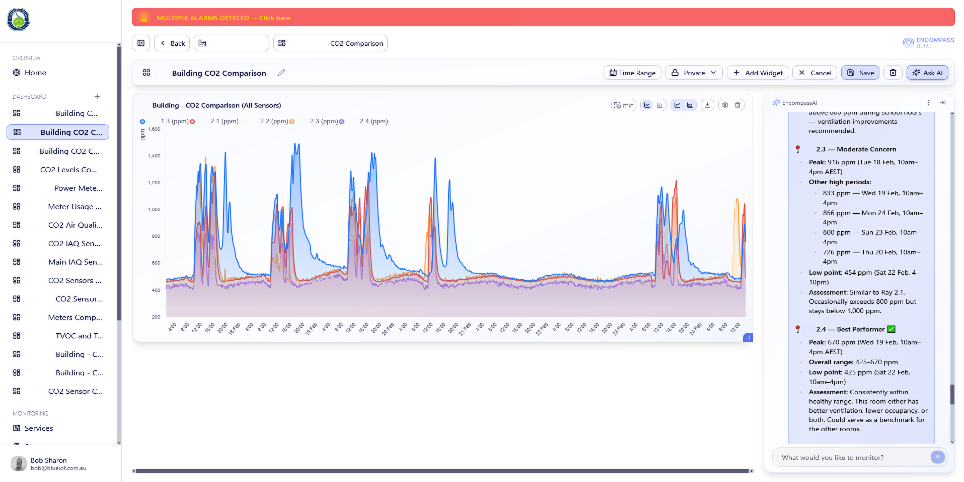
  • Carbon Dioxide (CO₂): A proxy for ventilation, with levels above 1,000 ppm linked to drowsiness. Aim for 800 ppm or lower.
  • Volatile Organic Compounds (VOCs): Emitted from paints, furnishings, and cleaning products, causing irritation and health risks.
  • Particulate Matter (PM₂.₅/₁₀): Linked to asthma, heart disease, and premature death.
  • Relative Humidity: Ideal range of 40-60% prevents viral persistence and mould growth.
  • Temperature: Influences comfort and pollutant release.

Smart sensors and IoT platforms enable continuous monitoring, threshold alerts, and integration with building systems. AI-driven analytics optimize IAQ in real time.

Design and Operational Strategies

To enhance IAQ, consider:

  • Maximizing Ventilation: Use demand-controlled systems to adjust airflow based on occupancy and pollutant levels.
  • Low-Emission Materials: Select low-VOC paints, adhesives, and furnishings.
  • Air Filtration: Employ HEPA filters, UV-C disinfection, or bi-polar ionisation.
  • Zoning and Airflow: Design airflow to prevent cross-contamination.
  • Maintenance: Regularly service HVAC systems and use non-toxic cleaning agents.
  • Monitoring: Deploy WELL-certified sensors and cloud-based dashboards for transparency.

Toward a Healthier Built Future

We spend ~90% of our time indoors, making IAQ a critical factor in modern life. As climate change, urban density, and evolving work patterns reshape our environments, IAQ must be prioritized in building design and operations. Smart buildings, digital twins, and cloud platforms provide the tools to transform IAQ into a managed asset, benefiting health, competitiveness, and sustainability.

Stay tuned for our next installment on this vital health and safety topic.
More News

Discover more articles and stay updated with our latest content

January 5, 2025
6
min read

The Future of IoT

Top Trends Shaping 2025 and Beyond

Michael Chen
Explore the latest IoT trends that will define 2025, including edge AI, 5G adoption, sustainability initiatives, and the growing importance of IoT security in enterprise deployments.
IoT Trends
Future Tech
Edge AI
5G
Sustainability
January 10, 2025
8
min read

IoT Security Best Practices

Protecting Your Connected Infrastructure

Sarah Johnson
Learn essential security practices to protect your IoT devices and infrastructure from cyber threats. Comprehensive guide covering device authentication, network security, and data protection.
IoT Security
Cybersecurity
Best Practices
Infrastructure
January 15, 2025
5
min read

Introducing EncompassBlue

The Future of IoT Management

Encompass Blue Team
Discover how EncompassBlue revolutionizes IoT device management with comprehensive monitoring, advanced security, and seamless integration across multiple sites.
IoT
Platform
Device Management
Security
January 20, 2025
7
min read

Edge Computing in IoT

Bringing Intelligence Closer to the Source

Dr. Elena Rodriguez
Discover how edge computing is revolutionizing IoT by processing data locally, reducing latency, and enabling real-time decision-making for critical applications.
Edge Computing
IoT
Real-time Processing
Latency
AI
January 25, 2025
9
min read

IoT Analytics and Data Management

Turning Sensor Data into Business Insights

James Mitchell
Learn how to transform raw IoT sensor data into actionable business insights through effective data management strategies, analytics platforms, and visualization techniques.
IoT Analytics
Data Management
Business Intelligence
Data Visualization
Machine Learning
January 30, 2025
8
min read

Industrial IoT Transformation

Modernizing Manufacturing Operations

Robert Chen
Explore how Industrial IoT is revolutionizing manufacturing through smart factories, predictive maintenance, and data-driven operations that improve efficiency and reduce costs.
Industrial IoT
Manufacturing
Smart Factory
Industry 4.0
July 5, 2025
6
min read

Combustible Cladding

A Persistent Global Threat and the Promise of Smart Monitoring Solutions

Blue IoT Team
The Grenfell Tower fire and Dubai's Tiger Tower blaze highlight the urgent need for innovative fire safety solutions. Discover how smart monitoring systems offer a proactive, cost-effective alternative to traditional cladding replacement.
Fire Safety
Smart Monitoring
Building Safety
Risk Management
February 5, 2025
10
min read

IoT Device Lifecycle Management

From Deployment to Decommissioning

Lisa Thompson
Master the complete IoT device lifecycle with strategies for deployment, monitoring, maintenance, and secure decommissioning that maximize value and minimize risks.
Device Management
IoT Lifecycle
Building Health